
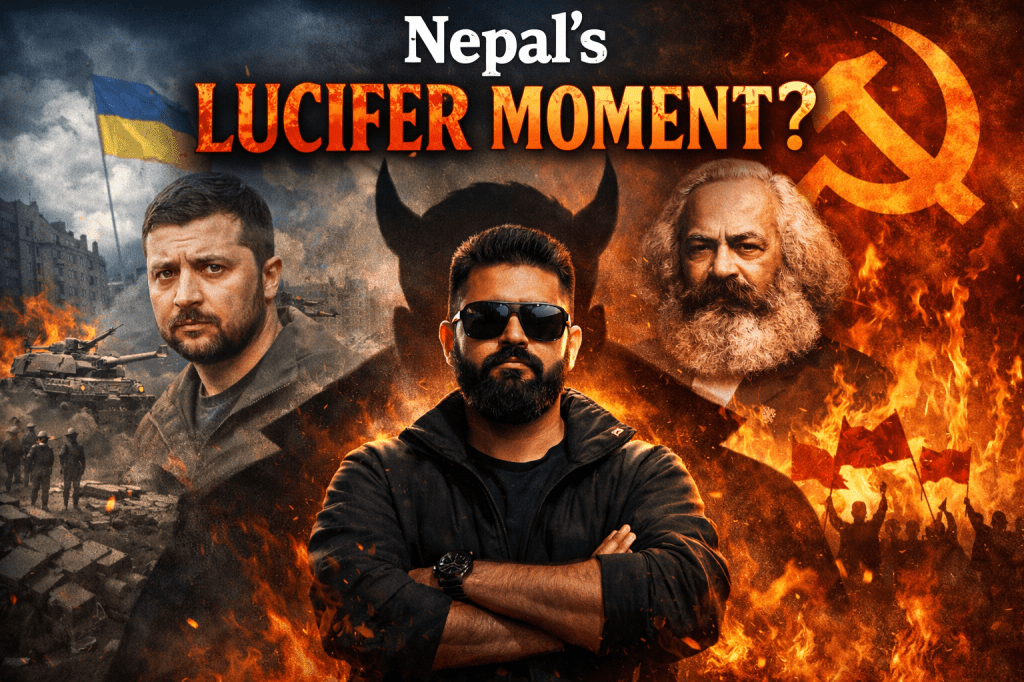
Wherever Balen Shah campaigns, crowds materialize. The former rapper turned Kathmandu mayor draws thousands simply wanting to see him, a phenomenon unprecedented in recent Nepali politics. Current polling suggests he and his Rastriya Swatantra Party (RSP) are poised for sweeping victory in March 2026—even in Jhapa-5, where he faces KP Sharma Oli on the former prime minister’s home turf. After three decades of broken promises from traditional parties, Nepalis seem ready for wholesale change.
Yet his path is shadowed by accusations. Communist parties label him a foreign agent, compare him to Zelensky warning Nepal will become “another Ukraine” or “another Venezuela,” and some blame him for the September 24, 2025 Singh Durbar fire. Political analyst Sourav and UML leaders call him “Lucifer”—a metaphor more revealing than intended.
The Lucifer Paradox
In calling Balen “Lucifer,” UML likely means to paint him as destructive and malevolent. But Lucifer—literally “light-bearer” in Latin—represents the beautiful rebel who challenges divine authority and brings forbidden knowledge. Milton’s Paradise Lost portrays him declaring “Better to reign in Hell than serve in Heaven”—resonating uncomfortably well with Balen’s positioning.
The metaphor inadvertently captures his appeal: the rebel bearing light into a system that has kept citizens in darkness through decades of corruption and broken promises. UML’s use reveals their desperation—after thirty years rotating the same faces through power while delivering minimal change, they face electoral reckoning. By invoking Lucifer rather than debating governance, they signal Balen represents an existential threat to their entire political order.
Conspiracy Theories as Last Resort
Most revealing is the Zelensky comparison. UML warns Nepal will become a failed state like Ukraine under Russian invasion or Venezuela under economic collapse if Balen wins.
This comparison is geopolitically absurd. Zelensky’s Ukraine isn’t a failed state—it’s defending sovereignty against Russian imperial aggression. Putin’s invasion had nothing to do with Zelensky’s personality; Putin explicitly denies Ukraine’s right to exist as an independent nation, views predating Zelensky by decades. To blame Zelensky for Russia’s invasion is victim-blaming elevated to geopolitical analysis. Moreover, Nepal’s strategic situation bears no resemblance to Ukraine’s—both India and China benefit from Nepal’s stability, not its collapse.
The Venezuela comparison is equally illiterate. Venezuela’s crisis resulted from decades of mismanagement, corruption, and authoritarian consolidation under leaders who systematically dismantled democratic institutions—not political outsiders challenging established elites. Blaming American sanctions ignores that economic collapse began long before significant sanctions, rooted in oil dependency and currency manipulation.
These conspiracy theories reveal Communist parties have nothing left but fear-mongering. After thirty years in power—UML alone has given Nepal multiple prime ministers—they cannot point to transformative achievements. Roads remain unpaved, electricity unreliable, youth emigrate seeking opportunities traditional parties failed to create. So they invoke foreign bogeymen, claiming America will use Balen to destabilize Nepal. This is classic authoritarian rhetoric: when domestic legitimacy evaporates, blame external enemies.
The tragic irony? Communist parties themselves have proven remarkably pliable to foreign influence when convenient, spending decades playing India and China against each other while delivering little to ordinary Nepalis.
The Mayoral Record
Sudip Shrestha’s Setopati examination provides crucial context. Balen’s three years governing Kathmandu demonstrated both promise and peril.
What worked: He brought integrity to an office historically associated with graft, challenged entrenched interests, and refused to play by old rules.
What failed: Nearly every major promise went unfulfilled. The waste management system never materialized. Incineration projects were abandoned. Waste segregation never happened. Claims about creating jobs and exporting organic fertilizer proved empty.
Authoritarian patterns emerged: bulldozers against street vendors without providing alternatives, refusal to consult ward chairpersons or federal officials, attempts to demolish legally built homes without court orders. Most telling: Kathmandu Metropolitan City recorded the lowest capital expenditure among major municipalities despite having Nepal’s largest budget.
Yet voters appear willing to overlook these failures, reasoning that even imperfect change beats predictable stagnation.
Strategic Calculations
Balen’s Jhapa-5 candidacy against Oli reveals calculated positioning. In Janakpur, he declared himself a “son of Madhesh”—striking given he told Setopati three years ago he belonged to a “Suryavanshi royal family,” explicitly rejecting Madhesi identity. He’s reversed his opposition to federalism and promises 10 million tourists annually to Janakpur—wildly disconnected from Nepal’s reality of approximately 1 million total tourists. These shifts suggest he’s learning conventional political rhetoric, promising what constituencies want to hear.
Why Balen?
Narayan Wagle reframes the debate: “The question isn’t Balen—it’s ourselves.” Balen didn’t manufacture his appeal—he channels genuine rage at a political class that failed to deliver governance or accountability for thirty years. His confrontational style resonates because it mirrors how many Nepalis feel.
Wagle’s uncomfortable question becomes urgent with victory likely: What do voters actually expect him to accomplish? Are those expectations grounded in reality? The Lucifer metaphor captures this tension: Are voters seeking someone who will genuinely bring light—transparency, accountability, competent governance—or simply drawn to a rebel who promises to burn down a corrupt system, consequences be damned?
The Governance Challenge
When Balen becomes prime minister, he inherits challenges exponentially more complex than running Kathmandu: building coalitions, navigating federal-provincial-local tensions he previously ignored, managing delicate relations with India and China amid foreign agent accusations, addressing systemic failures in education and healthcare that three decades of traditional parties couldn’t solve.
His mayoral record suggests significant gaps between rhetoric and implementation. Winning power through anti-establishment appeal differs entirely from building functional bureaucracies and delivering sustained development.
Light-Bearer or Destroyer?
The likely RSP victory will signal the most dramatic political transformation in Nepal since the monarchy’s end. But the deeper question transcends electoral outcomes: Can Balen actually govern better than those he’s replacing?
The Lucifer metaphor and conspiracy theories about Ukraine reveal the bankruptcy of old parties’ arguments while hinting at genuine challenges Balen will face navigating Nepal’s position between major powers. The difference is that India and China both benefit from Nepal’s stability, not its collapse.
The crowds gathering to glimpse Balen represent both hope and danger—hope that change is finally possible, danger that charisma might prove insufficient for the patient work of building functional governance. Nepal will soon discover whether its light-bearer can actually illuminate a path forward, or whether the country has simply traded one set of broken promises for another, more charismatic version.
But one thing is certain: when political parties resort to calling opponents Lucifer and warning of Ukrainian collapse, they’ve conceded their own record cannot withstand scrutiny. Nepal’s voters appear to have reached exactly that conclusion.
 Ved Vani Community Literacy Forum