The Richmen’s Club That Nepal Never Had

Dr. Rajendra K Panthee

Picture from Balen Shah’s Facebook!

Sometimes I wonder whether some of our newest political heroes in Nepal simply chose the wrong career.

Perhaps they should never have entered government at all.

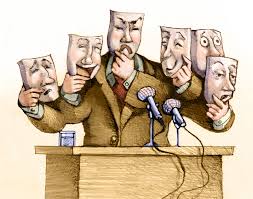
Instead, they should have established a national institution called the Rich Men’s Club for Nepal’s Development.

Membership would be simple. You must already have enough money that politics cannot tempt you. You must sincerely love Nepal. And you must be fully convinced that everyone who governed before you was either corrupt, incompetent, or both.

Confidence has never been in short supply.

The Club would have obvious advantages. Its members could build schools without first declaring every existing school a failure. They could finance hospitals without turning administrative reshuffling into public spectacle. They could support universities without discovering halfway through that institutions cannot function when leadership is abruptly removed without due process.

They could fund scholarships instead of exposing how fragile national systems can be when handled without care. They could experiment freely and revise quietly.

Most importantly, they could spend their own money while testing their own ideas.

Citizens would applaud. Nobody would object. Everyone likes philanthropy.

What people fear is something else. They fear becoming unwilling participants in political experiments.

The problem begins when success in media, business, or public visibility starts to look like qualification for constitutional leadership.

Business rewards speed. Democracy rewards restraint.

Business celebrates disruption. Democracy survives because institutions are deliberately difficult to disrupt.

In a company, yesterday’s strategy can be abandoned overnight. In a constitutional system, institutions exist because they were built through long struggle and painful compromise.

That difference matters.

Yet recent political practice suggests a different understanding of governance. It resembles a simple pattern. Announce boldly. Receive applause. Encounter legal difficulty. Clarify. Revise. Then explain that revision shows maturity.

Repeat as necessary.

Citizens have already adapted. They no longer react to the first announcement. They wait for the correction.

The rise of the Rastriya Swatantra Party was built on real public frustration. That frustration was justified. Established parties have failed repeatedly on governance, accountability, and delivery. Rabi Lamichhane’s appeal came from positioning himself outside that failure.

That appeal translated into political power. It did not automatically translate into constitutional competence.

Rabi Lamichhane’s political brand helped create the belief that a new kind of leadership could rescue Nepal from old habits. But governing a republic is not the same as exposing a scandal on television or winning public applause for speaking hard truths. It requires respect for law, procedure, and the limits of authority.

Gyanendra Shahi has been among the clearest voices exposing that contradiction. He has criticized RSP for rising on public anger and then behaving as if it stands above the same political rules it used to condemn. That criticism matters because it comes from inside the wider opposition space and shows that the complaint is no longer only external. It is now part of the political conversation itself.

The same problem appears in the rise of Balen Shah. He came from outside the old political class. He had money, talent, visibility, and a public image built around independence. Many people trusted him because they believed he was not part of the corrupt machinery that had disappointed them for years.

That trust was understandable. It was also dangerous if it became blind faith.

If a person enters public office with wealth and good intentions, that is not a sin. The problem begins when he starts treating state institutions as if they were private projects that can be redesigned by instinct. Government is not a startup. It is not a foundation. It is not a club. It is the formal arrangement through which a diverse and often quarrelsome society manages power without destroying itself.

That is why constitutional norms exist.

This is where the richer satire lies. If these leaders already had money, and if they genuinely wanted to serve the country, then the honest path would have been to serve first through private or civic institutions. They could have built schools, hospitals, scholarship funds, local development trusts, research centers, and civic programs. They could have shown public spirit without touching the machinery of the state.

That route would have done two things.

It would have protected constitutional government from being treated as a laboratory.

And it would have given them the very thing they lack now, practical experience in handling complexity.

A country is not run by outrage alone. It is run through compromise, restraint, process, and an acceptance that every decision has consequences beyond the headline. A mayor, minister, or prime minister cannot simply act on impulse and then expect legality to catch up later.

That is why some of the actions associated with the current RSP leadership have created unease. Strong declarations often arrive before the legal foundation is secure. Public relations moves sometimes appear to matter more than institutional durability. Even the cabinet can look more like a showcase of youthful enthusiasm than a serious instrument of statecraft.

The home minister, the education minister, and others may all carry the burden of this same style. They are expected to perform change quickly, visibly, and dramatically. But performance is not the same as governance. And novelty is not the same as competence.

The problem becomes even clearer when this same instinct is applied to the poor.

A government can claim to be modern and disciplined, but if it shows little compassion toward sukumbasi, informal workers, and people living on the edge of survival, then it is not reforming the state. It is hardening it.

Reports of holding centers being emptied with demands for Rs 25,000, the public anger after flooding forced some of those centers to be shifted, and the outrage over how vulnerable families were handled all point to the same failure. Rules are necessary. But rules without study, without context, and without humanity are not governance. They are punishment dressed as order.

A state that cannot understand the difference between discipline and cruelty will eventually lose its moral authority.

Yubaraj Dulal has also spoken forcefully against the same double standard. He has treated RSP’s approach to the provincial question and its wider conduct as dishonest toward the people rather than as some innocent administrative adjustment. That matters because it shows the criticism is not just about style. It is about the party’s willingness to say one thing and do another when it suits power. The provincial question especially reveals the problem, because a federal structure built through sacrifice cannot simply be brushed aside by political impatience. The decision is not neutral. It is a political message about what kind of state the party thinks Nepal should become.

The same concern appears in the use of fines and enforcement. It is one thing to insist on order. It is another to impose penalties without asking who will suffer most. When poor people are punished harshly for violations that the wealthy can absorb with ease, the law stops looking neutral. It starts looking class based.

The death of Ganesh Nepali brought that cruelty into sharp focus. According to reporting and parliamentary debate, a poor ride-hailing driver was fined and then later died after a self-immolation attempt, turning a routine enforcement action into a moral scandal. Whatever one thinks of rules, no civilized government can dismiss such a case as ordinary administration. It should have forced a deeper reflection on how the state treats the poor, the desperate, and the powerless.

That is why public criticism of harsher fines matters. People are not rejecting rules. They are rejecting a system that appears eager to punish the weak while speaking gently to the powerful.

Nepal’s democratic institutions were not handed down by benevolent rulers. They were built through resistance against Rana rule, through the struggle against Panchayat, through democratic movements, and through the sacrifices of people who believed that the country should be governed by rules, not personalities.

Those sacrifices created a system that is imperfect but precious.

To break its norms in the name of change is not courage. It is carelessness.

To appoint near and dear ones to key posts while speaking the language of merit is not reform. It is old patronage in new clothing. To talk about efficiency while treating the poor as administrative inconvenience is not compassion. It is class arrogance.

This is why the idea of a Rich Men’s Club is more than satire. It is a warning. If people have wealth, sincerity, and public trust, let them prove themselves outside the state first. Let them learn how difficult public life is before taking control of it. Let them discover that running a country is not the same as funding a project or speaking in slogans.

If they do that, they may one day become better leaders. They may come to understand that institutions are not obstacles to be defeated but safeguards to be respected. They may also understand that justice without empathy is only a cleaner form of cruelty.

And citizens, having watched them serve without power, would trust them more when they finally do enter government.

That is the real irony.

If these men had chosen the private route first, they might have earned the authority they now assume.

Instead, they entered the state too early and began learning at the public’s expense.

That is an expensive education.

And in every democracy, it is the people who pay the tuition.
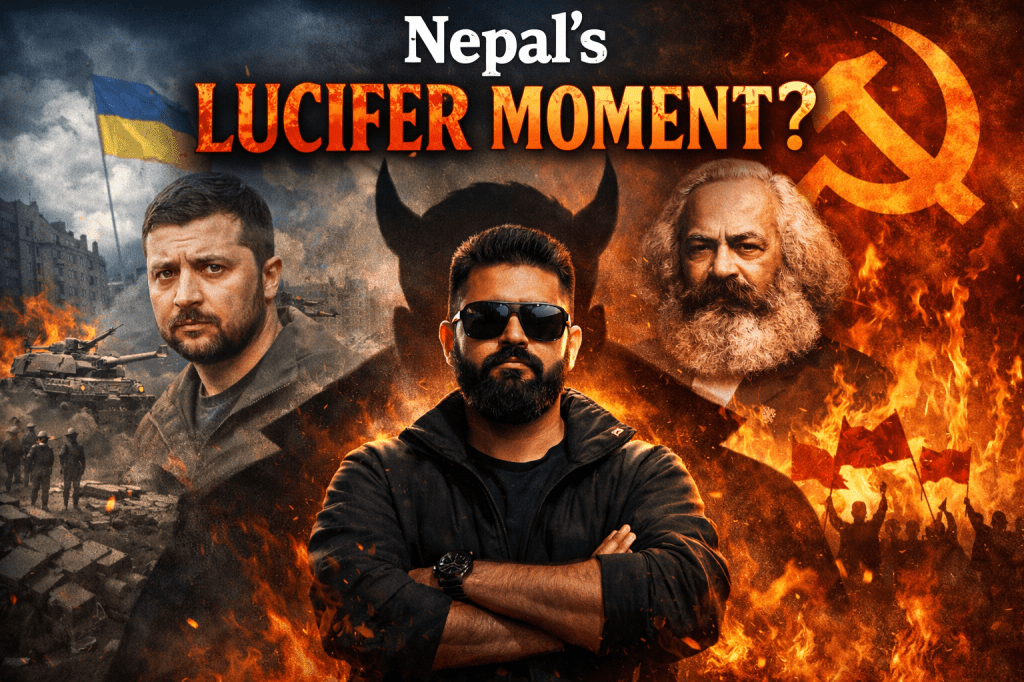
Balen Shah’s March Toward Power: Nepal’s Lucifer Moment

Image Created by AI

Wherever Balen Shah campaigns, crowds materialize. The former rapper turned Kathmandu mayor draws thousands simply wanting to see him, a phenomenon unprecedented in recent Nepali politics. Current polling suggests he and his Rastriya Swatantra Party (RSP) are poised for sweeping victory in March 2026—even in Jhapa-5, where he faces KP Sharma Oli on the former prime minister’s home turf. After three decades of broken promises from traditional parties, Nepalis seem ready for wholesale change.

Yet his path is shadowed by accusations. Communist parties label him a foreign agent, compare him to Zelensky warning Nepal will become “another Ukraine” or “another Venezuela,” and some blame him for the September 24, 2025 Singh Durbar fire. Political analyst Sourav and UML leaders call him “Lucifer”—a metaphor more revealing than intended.

The Lucifer Paradox

In calling Balen “Lucifer,” UML likely means to paint him as destructive and malevolent. But Lucifer—literally “light-bearer” in Latin—represents the beautiful rebel who challenges divine authority and brings forbidden knowledge. Milton’s Paradise Lost portrays him declaring “Better to reign in Hell than serve in Heaven”—resonating uncomfortably well with Balen’s positioning.

The metaphor inadvertently captures his appeal: the rebel bearing light into a system that has kept citizens in darkness through decades of corruption and broken promises. UML’s use reveals their desperation—after thirty years rotating the same faces through power while delivering minimal change, they face electoral reckoning. By invoking Lucifer rather than debating governance, they signal Balen represents an existential threat to their entire political order.

Conspiracy Theories as Last Resort

Most revealing is the Zelensky comparison. UML warns Nepal will become a failed state like Ukraine under Russian invasion or Venezuela under economic collapse if Balen wins.

This comparison is geopolitically absurd. Zelensky’s Ukraine isn’t a failed state—it’s defending sovereignty against Russian imperial aggression. Putin’s invasion had nothing to do with Zelensky’s personality; Putin explicitly denies Ukraine’s right to exist as an independent nation, views predating Zelensky by decades. To blame Zelensky for Russia’s invasion is victim-blaming elevated to geopolitical analysis. Moreover, Nepal’s strategic situation bears no resemblance to Ukraine’s—both India and China benefit from Nepal’s stability, not its collapse.

The Venezuela comparison is equally illiterate. Venezuela’s crisis resulted from decades of mismanagement, corruption, and authoritarian consolidation under leaders who systematically dismantled democratic institutions—not political outsiders challenging established elites. Blaming American sanctions ignores that economic collapse began long before significant sanctions, rooted in oil dependency and currency manipulation.

These conspiracy theories reveal Communist parties have nothing left but fear-mongering. After thirty years in power—UML alone has given Nepal multiple prime ministers—they cannot point to transformative achievements. Roads remain unpaved, electricity unreliable, youth emigrate seeking opportunities traditional parties failed to create. So they invoke foreign bogeymen, claiming America will use Balen to destabilize Nepal. This is classic authoritarian rhetoric: when domestic legitimacy evaporates, blame external enemies.

The tragic irony? Communist parties themselves have proven remarkably pliable to foreign influence when convenient, spending decades playing India and China against each other while delivering little to ordinary Nepalis.

The Mayoral Record

Sudip Shrestha’s Setopati examination provides crucial context. Balen’s three years governing Kathmandu demonstrated both promise and peril.

What worked: He brought integrity to an office historically associated with graft, challenged entrenched interests, and refused to play by old rules.

What failed: Nearly every major promise went unfulfilled. The waste management system never materialized. Incineration projects were abandoned. Waste segregation never happened. Claims about creating jobs and exporting organic fertilizer proved empty.

Authoritarian patterns emerged: bulldozers against street vendors without providing alternatives, refusal to consult ward chairpersons or federal officials, attempts to demolish legally built homes without court orders. Most telling: Kathmandu Metropolitan City recorded the lowest capital expenditure among major municipalities despite having Nepal’s largest budget.

Yet voters appear willing to overlook these failures, reasoning that even imperfect change beats predictable stagnation.

Strategic Calculations

Balen’s Jhapa-5 candidacy against Oli reveals calculated positioning. In Janakpur, he declared himself a “son of Madhesh”—striking given he told Setopati three years ago he belonged to a “Suryavanshi royal family,” explicitly rejecting Madhesi identity. He’s reversed his opposition to federalism and promises 10 million tourists annually to Janakpur—wildly disconnected from Nepal’s reality of approximately 1 million total tourists. These shifts suggest he’s learning conventional political rhetoric, promising what constituencies want to hear.

Why Balen?

Narayan Wagle reframes the debate: “The question isn’t Balen—it’s ourselves.” Balen didn’t manufacture his appeal—he channels genuine rage at a political class that failed to deliver governance or accountability for thirty years. His confrontational style resonates because it mirrors how many Nepalis feel.

Wagle’s uncomfortable question becomes urgent with victory likely: What do voters actually expect him to accomplish? Are those expectations grounded in reality? The Lucifer metaphor captures this tension: Are voters seeking someone who will genuinely bring light—transparency, accountability, competent governance—or simply drawn to a rebel who promises to burn down a corrupt system, consequences be damned?

The Governance Challenge

When Balen becomes prime minister, he inherits challenges exponentially more complex than running Kathmandu: building coalitions, navigating federal-provincial-local tensions he previously ignored, managing delicate relations with India and China amid foreign agent accusations, addressing systemic failures in education and healthcare that three decades of traditional parties couldn’t solve.

His mayoral record suggests significant gaps between rhetoric and implementation. Winning power through anti-establishment appeal differs entirely from building functional bureaucracies and delivering sustained development.

Light-Bearer or Destroyer?

The likely RSP victory will signal the most dramatic political transformation in Nepal since the monarchy’s end. But the deeper question transcends electoral outcomes: Can Balen actually govern better than those he’s replacing?

The Lucifer metaphor and conspiracy theories about Ukraine reveal the bankruptcy of old parties’ arguments while hinting at genuine challenges Balen will face navigating Nepal’s position between major powers. The difference is that India and China both benefit from Nepal’s stability, not its collapse.

The crowds gathering to glimpse Balen represent both hope and danger—hope that change is finally possible, danger that charisma might prove insufficient for the patient work of building functional governance. Nepal will soon discover whether its light-bearer can actually illuminate a path forward, or whether the country has simply traded one set of broken promises for another, more charismatic version.

But one thing is certain: when political parties resort to calling opponents Lucifer and warning of Ukrainian collapse, they’ve conceded their own record cannot withstand scrutiny. Nepal’s voters appear to have reached exactly that conclusion.

When Theory Meets the Body: Porn, Violence, and the Urgency of Conversation

I attended a powerful session titled “Theory and Resistance” at MLA 2026 that tackled difficult and uncomfortable truths about violence in its multiple manifestations. The panelists—Keith Feldman (UC Berkeley), Carol Hay (UMass Lowell), Julia Chi Yan Ng (Goldsmiths, University of London), Sandra Ruiz (University of Illinois, Urbana-Champaign), Zahi Zalloua (Whitman College), and P. Khalil Saucier (Bucknell University)—addressed violence against Jews, violence against Muslims especially in Gaza, the politics of othering in contemporary American politics, and violence in intimate relationships. Rather than offering prescriptive solutions, the presenters invited sustained engagement with the political, cultural, and embodied complexities of how violence operates across different contexts.

Philosophical Frameworks and Comparative Contexts

Analytical philosopher Carol Hay’s presentation examined erotica through a resistance framework, interrogating not sexuality itself but rather the circulation and moral evaluation of violent sexual content. Drawing on feminist philosophical work, particularly Mari Mikkola’s scholarship on objectification and pornography, Hay explored how regulatory frameworks, production practices, and access mechanisms differ significantly between the United States and Canada. This comparative approach illuminated how national contexts shape both the availability of violent content and public discourse surrounding it.

Hay’s analysis resonates with empirical findings documented in recent Canadian Broadcasting Corporation programming. In a CBC Radio feature moderated by Matt Galloway, researchers and clinicians identified troubling patterns in adolescent sexual socialization: young men increasingly derive sexual scripts from pornographic content that normalizes aggression as desire, while young women report experiencing choking, verbal degradation, and other violent acts that they have been socialized to accept as conventional sexual practice (CBC Radio).

The Material Consequences of Abstracted Violence

The urgency of this issue extends beyond theoretical concern. While fatalities from sexual choking remain statistically uncommon, emergency department visits related to such practices are not. The harms are corporeal, documented, and frequently unaddressed due to shame, normalization, or lack of informed consent frameworks.

As Zahi Zalloua argued in his MLA presentation, violence becomes most insidious when abstracted—when theoretical distance obscures lived consequences. Similarly, Sandra Ruiz’s scholarship consistently emphasizes that critical theory must account for embodied experience; theoretical frameworks divorced from material reality risk becoming exercises in intellectual abstraction rather than tools for understanding and intervention.

Pedagogical and Parental Responsibility

This intersection of theory and praxis demands concrete action, particularly in educational and familial contexts. Young people require explicit counter-narratives to pornographic sexual scripts:

  • Daughters need clear articulation that strangulation, humiliation, and pain inflicted by partners constitutes violence, not intimacy, regardless of how such acts are framed or normalized in media.
  • Sons need direct instruction that pornography does not constitute sex education and that authentic intimacy neither requires nor benefits from domination or violence.

These conversations, however uncomfortable, represent essential pedagogy—one that bridges the gap between theoretical analysis of power and resistance in academic contexts and their manifestations in private spaces.

The Embodied Stakes of Critical Theory

If scholars can analyze violence, power, and resistance in literature, philosophy, and geopolitical contexts, we must extend that analytical capacity to examining violence in intimate spaces, digital consumption, and cultural silences. The alternative is a critical theory that remains intellectually comfortable precisely because it avoids confronting the bodies—and bodily harms—that exist beyond the seminar room.

Nepal in the Age of Political Theater

Image from The Kathmandu Post

Democracy does not usually die on the day soldiers take over the streets or leaders cancel elections. It dies much earlier—when institutions stop working, when truth fractures into competing stories, and when elections become ceremonies rather than choices. By the time people openly admit democracy is dead, it has often been dead for years.

Nepal today stands dangerously close to that moment of delayed recognition.

The killings of Gen Z protesters on September 8, 2025—76 lives lost, including a 12-year-old child—were treated as a tragic rupture in an otherwise functioning democratic system. The prime minister resigned. Elections were scheduled for March 5, 2026. International observers praised “youth power” and “democratic correction.”

But this framing may be comforting rather than accurate.

The harder question is this: what if Nepal’s democracy had already stopped functioning long before the bullets were fired? What if the coming election is not democratic renewal, but democratic theater—rituals performed over a system that no longer responds to citizens?

The Quiet Capture of Democracy

Democratic death in Nepal has not come through a single coup or constitutional rupture. It has come through slow institutional hollowing.

Courts appear formally independent yet are widely perceived as politically negotiated. Election commissions conduct polls, but outcomes are increasingly treated as bargaining chips rather than mandates. Parliament exists, but governance happens elsewhere—through coalitions formed not to govern, but to block others from governing.

This is not the absence of democracy’s forms. It is the absence of democracy’s function.

When elections no longer resolve political conflict—when they merely postpone it—democracy enters a terminal phase.

The Collapse of Shared Reality

What followed September 8 should alarm us more than the violence itself.

Within hours, Nepalis were living in entirely different realities. Some believed the protests were foreign-engineered. Others blamed neighboring powers. Still others insisted old parties orchestrated chaos to justify repression. Each explanation carried fragments of plausibility—and none commanded broad agreement.

This is what democratic collapse looks like in the 21st century: epistemological breakdown.

When citizens cannot agree on what happened, who is responsible, or whether authority is legitimate, democratic decision-making becomes impossible. Voting requires shared facts before shared rules. Nepal is losing both.

What is striking—and deeply worrying—is how fast this happened. Other democracies took years, even decades, to reach this point. Nepal reached it in days.

The Geopolitical Cage

Nepal’s crisis cannot be understood without confronting its geography.

Caught between two giants—India and China—Nepal exists in a state of permanent external balancing. Neither power can dominate completely, but both can destabilize endlessly. This does not protect democracy. It corrodes it.

Governments are no longer judged primarily by competence or public mandate, but by perceived alignment. Domestic political struggles become proxy contests. Elections produce not authority, but leverage.

In such a system, no government truly governs—and no opposition truly waits its turn. Everyone negotiates sideways.

The result is not sovereignty, but suspension.

Elections as Performance

This is why so many Nepalis approach the March 5 election with cynicism rather than hope.

Before a single vote is cast, coalitions are being discussed to neutralize outcomes. Young activists are torn between participation and boycott, knowing both choices may legitimize a broken process. Ordinary citizens expect dispute, paralysis, and blame—regardless of results.

When nobody believes an election will settle anything, the election has already failed its democratic purpose.

What remains is performance: ballots, speeches, observers, statements—without resolution.

What This Moment Actually Demands

The question before Nepal is not simply who should win on March 5.

It is whether Nepalis are willing to acknowledge democratic death honestly—because only honest acknowledgment creates space for renewal.

Pretending democracy is healthy when it is not does more damage than admitting its failure. It delays reform. It exhausts citizens. It turns courage into silence and sacrifice into symbolism.

The young people who died on September 8 did not die for theater. They died confronting a system that no longer listened.

If Nepal continues performing democracy without repairing it—without restoring institutional credibility, shared truth, and genuine accountability—the rituals will continue while the substance disappears.

Democracy rarely announces its death. It waits for us to notice.

March 5 will not tell us whether democracy survives.
It will tell us whether we are ready to face the truth about its condition.

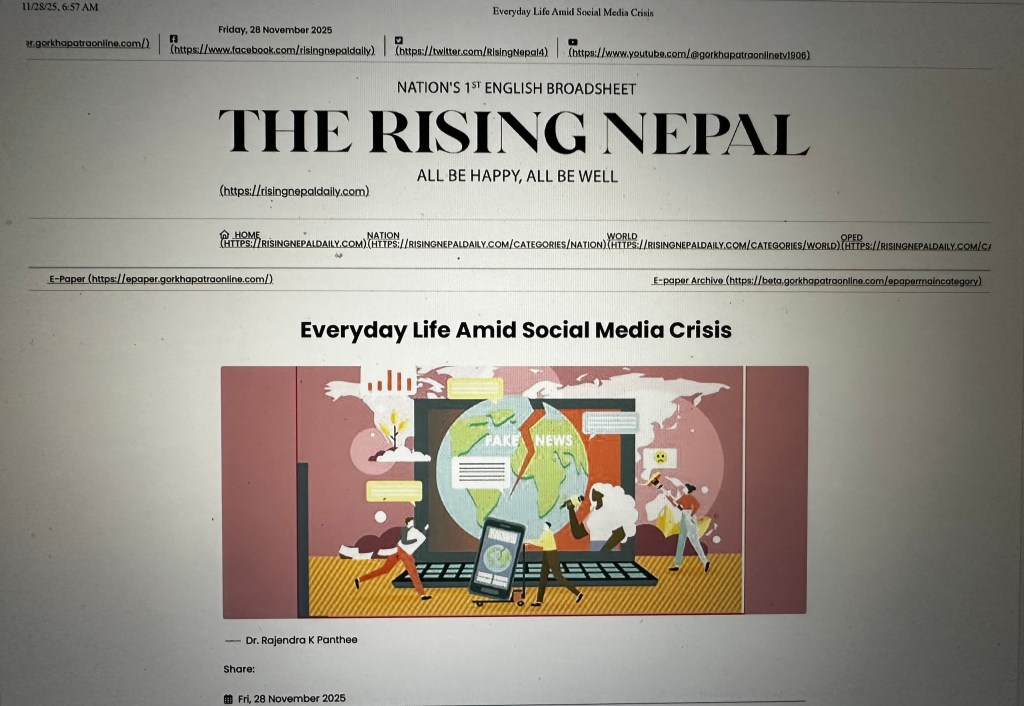
Everyday Life in Nepal at the Time of Social Media Crisis

Image from The Rising Nepal

Nepal is going through a very tough time right now. After the Gen Z movement showed how badly the old political parties had failed, we have elections scheduled for March 5, 2026. But those same parties don’t want to face voters anymore because people have seen their decades of failure. So they’re using social media manipulation like never before.

The worst part is how they’re using AI now. UML distributed petrol and food coupons to their cadres for rallies, and when caught, they claimed the photos were AI-generated. When reports came out about money found at Deuba’s house, he dismissed it as AI-created. Now the public faces an impossible situation: how do you know what’s real when anyone can say “that’s AI” whenever something inconvenient surfaces? This shows why Nepal’s social media problem is far more dangerous than what Western countries face.

Social Media Manipulation in Nepal

Western countries definitely have fake news problems. Trump’s use of “alternative facts” in his first presidential term, political polarization creating separate realities for different groups, Russian and Chinese interference during elections, QAnon conspiracies, anti-vaccine movements. Even Western rationalist traditions can’t really protect against misinformation.

But here’s the key difference. In Western countries, even during election chaos, the manipulation stays mostly at the political level. People argue about which news channel or politician to trust. But their everyday life remains protected by functioning institutions. Doctors are licensed, charities are verified by authorities, schools meet accreditation standards. These institutions aren’t perfect, but they work at a basic level.

Role of Culture in Media Manipulation

In Nepal, manipulation has penetrated every aspect of daily life. In healthcare, can you really tell if a doctor is qualified? Professional licensing exists on paper, but enforcement became very weak after we restored democracy and declared the republic. Why? Because major political parties cared more about keeping their party people happy than about professional standards. Unqualified people affiliated with parties got to practice medicine with almost no oversight. Same thing in education. Unqualified teachers got positions through political connections, not merit.

The charity sector often suffers from a lack of accountability, and the case of Dhurmus and Sunlali is a prime example. The beloved comedians first earned public trust through genuine humanitarian work, aiding Nepal’s earthquake victims and the impoverished Musahar community. They were rightly celebrated, and their social media influence channeled real donations. Success seemingly led them astray, though. They pivoted to an ill-conceived plan to build a cricket stadium, claiming they’d contribute to the sport sector since the government had been ineffective at such projects. The stadium would help reduce unemployment and provide other social benefits, they argued, using emotional appeals spread through social media to maintain support. This shift, funded by small public contributions, revealed a troubling desire to monetize their popularity, moving from humanitarian work to what many perceived as greed.

Many organizations now have impressive Facebook pages asking for donations with emotional appeals, but how do you verify which are genuine and which are scams? There’s no charity watchdog with real authority. This institutional weakness isn’t accidental. It’s the result of decades of party politics that corrupted everything. National projects became vehicles for party patronage instead of public service. This is exactly why the Gen Z movement happened. Young people saw this for years and got fed up. But now those same parties use social media manipulation to avoid accountability and try to stop the March 2026 elections.

All major parties operate “cyber armies” that constantly generate propaganda and attack critics. This isn’t just during elections, it’s 24/7. Professional journalism still exists but gets drowned out by social media content creators with no standards or accountability.

Look at Rabi Lamichhane. He went from TV personality to vigilante with cameras catching people in hotel rooms, then became a politician. Reports suggest he used to bargain with the corrupt people he “investigated.” Make a deal, your wrongdoing stays hidden. No deal, he exposes you. That’s not journalism, that’s a protection racket.

People like Punya Gautam, Rajib Khatry, Santosh Deuja mix politics and charity work with “journalism,” creating conflicts of interest. Anyone with a smartphone calls themselves a journalist, running YouTube channels that turn private matters like the Meena Dhakal marital dispute into national drama for views and money. AI made everything exponentially worse. Politicians now use the “AI defense.” Do something wrong, evidence comes out, just say “that’s AI-generated.”

Media Manipulation and Its Risk on Everyday Life

Different cultures think about truth and knowledge differently. Western culture emphasizes skepticism and demanding evidence. South Asian culture, including ours in Nepal, integrates different ways of knowing. We value rational analysis but also emotional intelligence, empirical facts but also spiritual understanding, individual judgment but also community wisdom. These are real strengths, not weaknesses.

But here’s the thing about our political culture. In Nepal, people are hardly judged based on actual skills or performance. We like or dislike people based on whether they’re from our political party, share our ethnic identity, fit into our social hierarchies. Actual competence and governance outcomes are often secondary.

A powerful manipulation tactic exploits our cultural respect for family. Political figures get positioned not as the leaders they actually are, but as emotional archetypes. KP Oli becomes “Baa,” father. Deuba becomes “Daju,” brother. Arju becomes “Bhauju,” sister-in-law. Sushila Karki was first called the nation’s “loving mother,” then quickly became a “foreign agent.”

The danger is people don’t evaluate these individuals based on their performance as prime ministers. They respond to the emotional archetype. When someone is “father,” people think wisdom, protection, authority, respect. Criticizing them feels like betraying family. This creates a dangerous generalization: father figures and mother figures can’t make mistakes, we shouldn’t scrutinize their actions, we should forgive their failures.

The Meena Dhakal situation became debates about “mother’s love,” forgetting to discuss her actual actions and character. The Aayus Thakuri and mother feud exploited the sacred mother-son relationship. Our cultural strengths in respecting family and valuing relationships become vulnerabilities when manipulators understand our psychology and use family framings to stop critical thinking.

Changing the Course of Action

Both Nepal and Western nations face manipulation, but the danger differs fundamentally. In the West, manipulation targets political opinions during election cycles. In Nepal, manipulation is constant and affects survival decisions in healthcare, charity, education, finance. In the West, institutions protect everyday life even during political interference. In Nepal, decades of party corruption eliminated this baseline protection.

When foreign actors influence Western elections, citizens might elect bad leaders, but their teachers are still certified, medications still regulated, charities still verified. In Nepal, people can’t trust political information, medical credentials, charity legitimacy, educational qualifications, all simultaneously, all the time.

We need digital literacy education adapted to our culture, using Buddhist and Hindu concepts as foundation, teaching people to recognize manipulation in healthcare, charity, education, finance. We need to strengthen investigative journalism to expose cyber armies and reveal hidden motivations. We need transparency requirements beyond politics for anyone soliciting donations or claiming expertise. We need public awareness about specific tactics: the “AI defense,” cyber army coordination, performative altruism fraud, vigilante journalism as extortion.

Call for Action

Back when I was an English literature student, I read Milton’s “Areopagitica” from 1644. Milton argued truth emerges through free encounter with falsehood, not censorship. Maybe Nepal’s chaos is something we must go through, like Western societies experienced before developing solutions.

But critical differences demand urgency. Viral content spreads instantly, not slowly like Milton’s pamphlets. We must develop journalism ethics and frameworks while confronting algorithmic manipulation, cyber armies, and AI fabrication. The current political crisis shows how fast things deteriorate. Delay costs are measured in destroyed livelihoods, damaged health, daily suffering.

Nepal has resources: philosophical traditions offering truth frameworks, cultural strengths in solidarity, proven adaptive resilience. The challenge is developing capacity to maintain these strengths while resisting exploitation. We need conscious action now in education, media support, transparency, and public awareness. This will determine whether technology serves our flourishing or enables exploitation. As Milton understood, this struggle is necessary for genuine understanding and cultural strength. The question is whether we’ll act with sufficient speed before costs become unbearable.