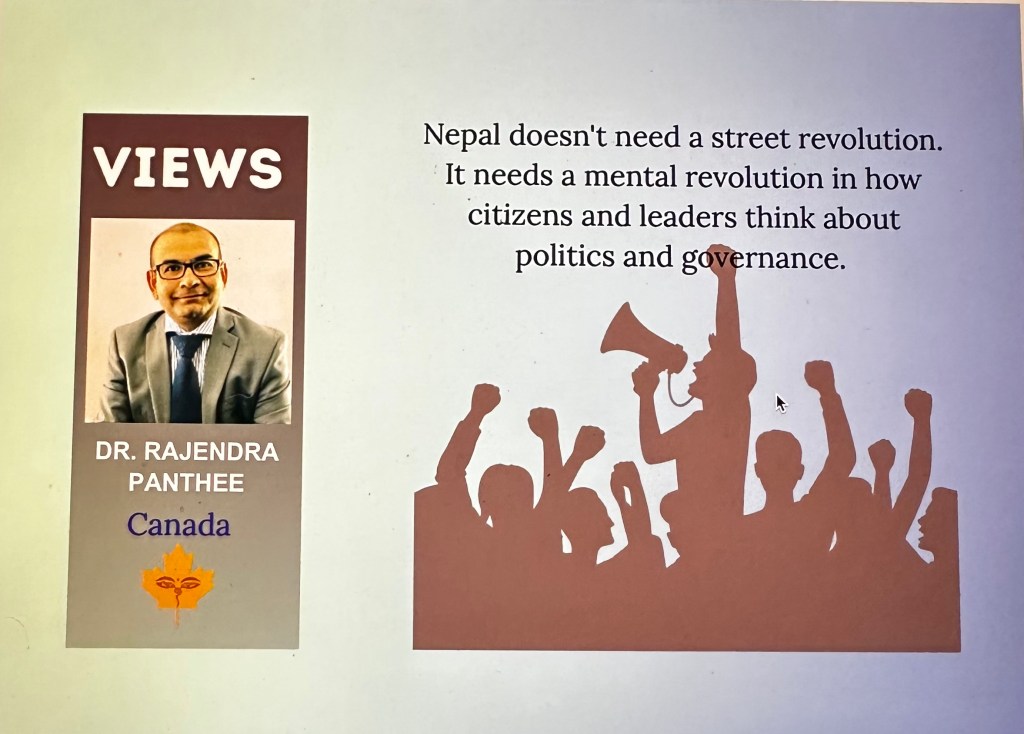
Please read my article published in Nepal Touch!
http://What Nepal Can Learn from Leaders Who Put National Interest First

Please read my article published in Nepal Touch!
http://What Nepal Can Learn from Leaders Who Put National Interest First
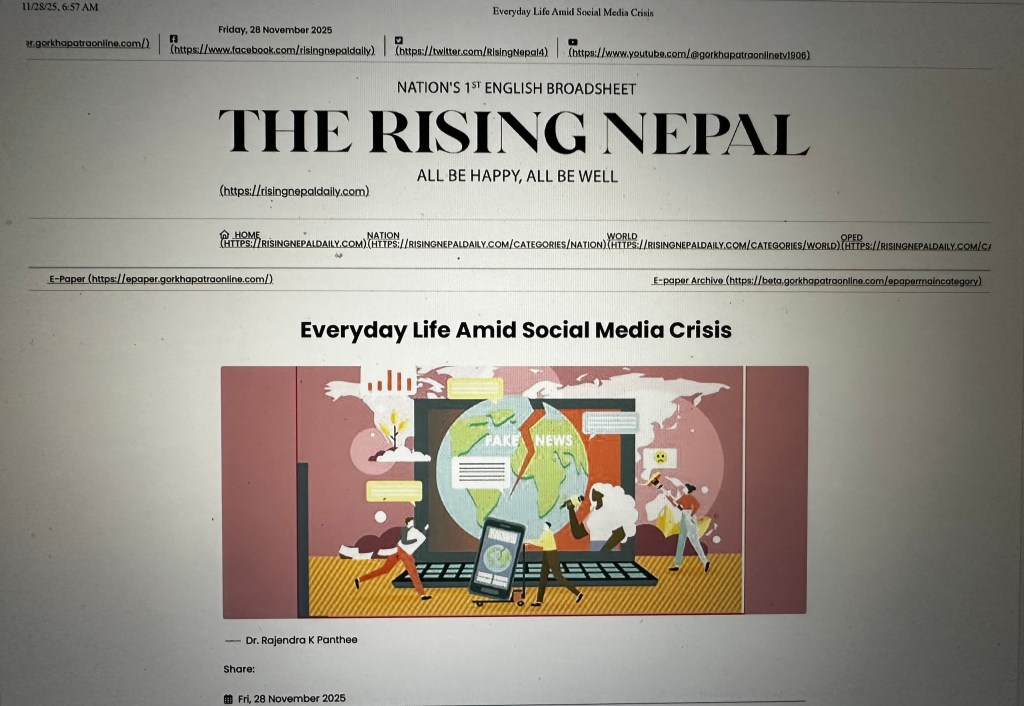
Nepal is going through a very tough time right now. After the Gen Z movement showed how badly the old political parties had failed, we have elections scheduled for March 5, 2026. But those same parties don’t want to face voters anymore because people have seen their decades of failure. So they’re using social media manipulation like never before.
The worst part is how they’re using AI now. UML distributed petrol and food coupons to their cadres for rallies, and when caught, they claimed the photos were AI-generated. When reports came out about money found at Deuba’s house, he dismissed it as AI-created. Now the public faces an impossible situation: how do you know what’s real when anyone can say “that’s AI” whenever something inconvenient surfaces? This shows why Nepal’s social media problem is far more dangerous than what Western countries face.
Social Media Manipulation in Nepal
Western countries definitely have fake news problems. Trump’s use of “alternative facts” in his first presidential term, political polarization creating separate realities for different groups, Russian and Chinese interference during elections, QAnon conspiracies, anti-vaccine movements. Even Western rationalist traditions can’t really protect against misinformation.
But here’s the key difference. In Western countries, even during election chaos, the manipulation stays mostly at the political level. People argue about which news channel or politician to trust. But their everyday life remains protected by functioning institutions. Doctors are licensed, charities are verified by authorities, schools meet accreditation standards. These institutions aren’t perfect, but they work at a basic level.
Role of Culture in Media Manipulation
In Nepal, manipulation has penetrated every aspect of daily life. In healthcare, can you really tell if a doctor is qualified? Professional licensing exists on paper, but enforcement became very weak after we restored democracy and declared the republic. Why? Because major political parties cared more about keeping their party people happy than about professional standards. Unqualified people affiliated with parties got to practice medicine with almost no oversight. Same thing in education. Unqualified teachers got positions through political connections, not merit.
The charity sector often suffers from a lack of accountability, and the case of Dhurmus and Sunlali is a prime example. The beloved comedians first earned public trust through genuine humanitarian work, aiding Nepal’s earthquake victims and the impoverished Musahar community. They were rightly celebrated, and their social media influence channeled real donations. Success seemingly led them astray, though. They pivoted to an ill-conceived plan to build a cricket stadium, claiming they’d contribute to the sport sector since the government had been ineffective at such projects. The stadium would help reduce unemployment and provide other social benefits, they argued, using emotional appeals spread through social media to maintain support. This shift, funded by small public contributions, revealed a troubling desire to monetize their popularity, moving from humanitarian work to what many perceived as greed.
Many organizations now have impressive Facebook pages asking for donations with emotional appeals, but how do you verify which are genuine and which are scams? There’s no charity watchdog with real authority. This institutional weakness isn’t accidental. It’s the result of decades of party politics that corrupted everything. National projects became vehicles for party patronage instead of public service. This is exactly why the Gen Z movement happened. Young people saw this for years and got fed up. But now those same parties use social media manipulation to avoid accountability and try to stop the March 2026 elections.
All major parties operate “cyber armies” that constantly generate propaganda and attack critics. This isn’t just during elections, it’s 24/7. Professional journalism still exists but gets drowned out by social media content creators with no standards or accountability.
Look at Rabi Lamichhane. He went from TV personality to vigilante with cameras catching people in hotel rooms, then became a politician. Reports suggest he used to bargain with the corrupt people he “investigated.” Make a deal, your wrongdoing stays hidden. No deal, he exposes you. That’s not journalism, that’s a protection racket.
People like Punya Gautam, Rajib Khatry, Santosh Deuja mix politics and charity work with “journalism,” creating conflicts of interest. Anyone with a smartphone calls themselves a journalist, running YouTube channels that turn private matters like the Meena Dhakal marital dispute into national drama for views and money. AI made everything exponentially worse. Politicians now use the “AI defense.” Do something wrong, evidence comes out, just say “that’s AI-generated.”
Media Manipulation and Its Risk on Everyday Life
Different cultures think about truth and knowledge differently. Western culture emphasizes skepticism and demanding evidence. South Asian culture, including ours in Nepal, integrates different ways of knowing. We value rational analysis but also emotional intelligence, empirical facts but also spiritual understanding, individual judgment but also community wisdom. These are real strengths, not weaknesses.
But here’s the thing about our political culture. In Nepal, people are hardly judged based on actual skills or performance. We like or dislike people based on whether they’re from our political party, share our ethnic identity, fit into our social hierarchies. Actual competence and governance outcomes are often secondary.
A powerful manipulation tactic exploits our cultural respect for family. Political figures get positioned not as the leaders they actually are, but as emotional archetypes. KP Oli becomes “Baa,” father. Deuba becomes “Daju,” brother. Arju becomes “Bhauju,” sister-in-law. Sushila Karki was first called the nation’s “loving mother,” then quickly became a “foreign agent.”
The danger is people don’t evaluate these individuals based on their performance as prime ministers. They respond to the emotional archetype. When someone is “father,” people think wisdom, protection, authority, respect. Criticizing them feels like betraying family. This creates a dangerous generalization: father figures and mother figures can’t make mistakes, we shouldn’t scrutinize their actions, we should forgive their failures.
The Meena Dhakal situation became debates about “mother’s love,” forgetting to discuss her actual actions and character. The Aayus Thakuri and mother feud exploited the sacred mother-son relationship. Our cultural strengths in respecting family and valuing relationships become vulnerabilities when manipulators understand our psychology and use family framings to stop critical thinking.
Changing the Course of Action
Both Nepal and Western nations face manipulation, but the danger differs fundamentally. In the West, manipulation targets political opinions during election cycles. In Nepal, manipulation is constant and affects survival decisions in healthcare, charity, education, finance. In the West, institutions protect everyday life even during political interference. In Nepal, decades of party corruption eliminated this baseline protection.
When foreign actors influence Western elections, citizens might elect bad leaders, but their teachers are still certified, medications still regulated, charities still verified. In Nepal, people can’t trust political information, medical credentials, charity legitimacy, educational qualifications, all simultaneously, all the time.
We need digital literacy education adapted to our culture, using Buddhist and Hindu concepts as foundation, teaching people to recognize manipulation in healthcare, charity, education, finance. We need to strengthen investigative journalism to expose cyber armies and reveal hidden motivations. We need transparency requirements beyond politics for anyone soliciting donations or claiming expertise. We need public awareness about specific tactics: the “AI defense,” cyber army coordination, performative altruism fraud, vigilante journalism as extortion.
Call for Action
Back when I was an English literature student, I read Milton’s “Areopagitica” from 1644. Milton argued truth emerges through free encounter with falsehood, not censorship. Maybe Nepal’s chaos is something we must go through, like Western societies experienced before developing solutions.
But critical differences demand urgency. Viral content spreads instantly, not slowly like Milton’s pamphlets. We must develop journalism ethics and frameworks while confronting algorithmic manipulation, cyber armies, and AI fabrication. The current political crisis shows how fast things deteriorate. Delay costs are measured in destroyed livelihoods, damaged health, daily suffering.
Nepal has resources: philosophical traditions offering truth frameworks, cultural strengths in solidarity, proven adaptive resilience. The challenge is developing capacity to maintain these strengths while resisting exploitation. We need conscious action now in education, media support, transparency, and public awareness. This will determine whether technology serves our flourishing or enables exploitation. As Milton understood, this struggle is necessary for genuine understanding and cultural strength. The question is whether we’ll act with sufficient speed before costs become unbearable.
 Ved Vani Community Literacy Forum