
Rajendra Kumar Panthee
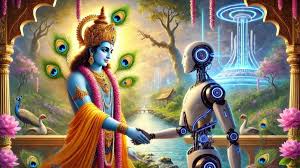
“बन्धुरात्मात्मनस्तस्य येनात्मैवात्मना जितः।
अनात्मनस्तु शत्रुत्वे वर्तेतात्मैव शत्रुवत्॥”
(Bandhur ātmātmanas tasya yenātmaivātmanā jitaḥ |
Anātmanas tu śhatrutve vartetātmaiva śhatru-vat ||)
Meaning: The mind can be our greatest friend or enemy, depending on how we control it. Self-mastery is essential for achieving balance and success.
Ancient Wisdom for Modern Classrooms
AI has entered our classrooms. I’ve watched it happen over the past two years. It brings extraordinary possibilities. Also profound ethical dilemmas. The Bhagavad Gita offers timeless insights into knowledge and right action. I’ve been studying the Gita, and these insights give us a spiritual framework for this transition. Technology and consciousness are colliding right now. Krishna’s teachings on self-effort (yatna), discernment (viveka), and selfless service (nishkama karma) have become unexpectedly relevant. They can guide how we bring AI into education and writing. Not as a crutch. As a lamp showing the path to true wisdom.
AI as Support for Self-Effort in Learning
The Bhagavad Gita talks a lot about self-effort (yatna) in acquiring true knowledge. How does this connect to AI in education? Technology should enhance a student’s intellectual journey. Not replace it. AI tutors and writing assistants can provide valuable scaffolding. Personalized feedback. Resources. But we must avoid creating dependency. Krishna’s advice to Arjuna in Chapter 6 about self-elevation through one’s own efforts reminds us something important. Real learning requires struggle.
Think about an ethical AI system in education. It would function like the ideal guru. Guiding students to find answers themselves. Not providing ready-made solutions. This preserves the sanctity of learning while harnessing technology’s benefits.
Maintaining Truth and Authenticity in AI-Assisted Writing
The Gita emphasizes satya (truth) and authentic expression. This provides crucial guidance for using AI in writing. AI tools can help with structure and grammar. Sure. But they risk promoting intellectual dishonesty when people use them to generate entire pieces of work. The concept of asteya (non-stealing) applies here. You’re passing off AI-generated content as your own? You’re violating this principle.
What would ethical use of writing AI look like? Using it as a starting point for your own ideas. Not as a replacement for original thought. The Gita warns against moha (delusion). This feels particularly relevant now. AI tools might generate plausible but false information. Users need to exercise buddhi yoga (discerning wisdom) in verifying outputs.
The Dharmic Educator’s Approach to AI
Teachers bringing AI into education must embody the Gita’s ideal of sthitaprajna. Wisdom and balance. AI should serve as an aid to teaching. Not a replacement for the human connection at the heart of education.
Krishna guided Arjuna through dialogue. He didn’t just give him answers. Educators should use AI the same way. Stimulate discussion and critical thinking. Not as a shortcut. The Gita teaches about performing one’s duty without attachment to results. This reminds educators what really matters. True understanding is the goal. Not just improved test scores or efficiency.
When evaluating AI tools, educators must apply the Gita’s principle of samatva (equality). We need to make sure these tools don’t perpetuate biases. Or disadvantage certain groups of students.
Conclusion
The Bhagavad Gita’s timeless wisdom gives us a moral compass for navigating AI in education and writing. We can apply principles like nishkama karma (selfless action) and jnana yoga (the path of wisdom). These make sure that powerful technologies serve human growth. Not undermine it. When does AI become dharmic? When it helps students develop their own understanding instead of providing easy answers. When it supports authentic expression instead of replacing it. When educators use it to enhance their sacred role instead of automating it. What we might call “Krishna-conscious AI” can become a true aid on the path to knowledge. It aligns with the Gita’s ultimate purpose. Awakening human potential and wisdom. How should we measure AI’s success in education? Not by efficiency. Not by convenience. But by how well it helps students and teachers fulfill their dharma of teaching and learning with integrity.
 Ved Vani Community Literacy Forum